

HOW TO OVERCOME FEAR OF HEIGHTS HIKING: PRACTICAL GUIDE AND SAFETY TIPS
- Altura Expeditions

- Dec 9, 2025
- 4 min read
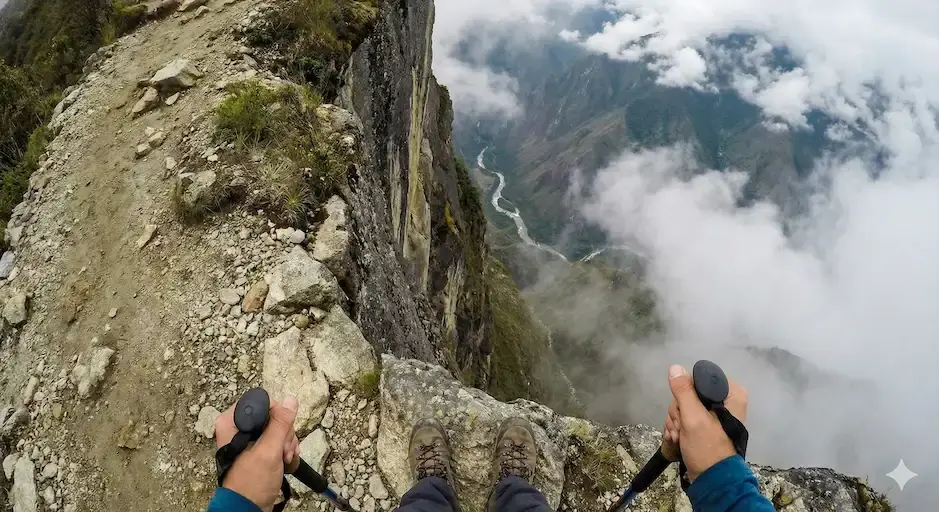
The desire to reach a summit or enjoy an alpine landscape often collides head-on with a powerful instinctive barrier: the fear of heights. If you feel your heart racing or your legs shaking when approaching an edge, it is fundamental that you understand you are not alone, nor is there anything defective about you. In the context of hiking and mountains, this reaction is an ancestral survival mechanism trying to protect you.
The goal of this guide is not to eliminate that protective instinct, but to teach you to dialogue with it so that it stops being a wall and becomes a simple caution signal. You have the capacity to enjoy the mountains; the key lies in how you approach them.
UNDERSTANDING THE DIFFERENCE BETWEEN RATIONAL FEAR AND BLOCKAGE
To begin your process of overcoming this, we must first establish a clear semantic distinction that will help you rationalize what you feel. There is a notable difference between physiological vertigo, which implies a dysfunction in the inner ear balance, and acrophobia or fear of heights, which is an anxious response to the perception of danger. Most hikers experience the latter.
Recognizing that your body functions well and is simply reacting exaggeratedly to a visual stimulus is the first step to regaining control. It is not a physical inability, but a mental management task that can be trained with patience and empathy towards oneself.
THE PRINCIPLE OF GRADUAL EXPOSURE IN THE MOUNTAINS
The most effective tool to deactivate the fear alarm in hiking is gradual exposure. Imagine your tolerance for heights like a muscle that has gone untrained for a long time; you would not try to lift a hundred kilos on your first day at the gym, and likewise, you should not try to cross a sharp ridge on your first outing. The strategy consists of choosing routes that challenge you slightly without driving you to panic.
Start with wide trails, preferably wooded, where the visual reference of the abyss is hidden by vegetation. These environments allow your brain to associate the slope and physical effort with safety, building a solid base of confidence before facing open spaces.
ROUTE PLANNING AND THE CONCEPT OF GENTLE GRADE
A crucial part of your success lies in prior planning from home. When studying a route, you must look for what we call a gentle grade. Avoid descriptions that include terms like aerial passages, scrambling, exposed, or ridge. Instead, look for open valleys or progressive ascents up soft slopes.
The success of this stage depends on predictability; knowing exactly what type of terrain you are going to step on reduces anticipatory anxiety. If during the walk you encounter a section that exceeds your current comfort level, remember that turning around is a victory of intelligence and self-knowledge, not a defeat. The mountain will still be there when you are ready.
THE GUIDE PARTNER TACTIC AND THE MIRROR EFFECT
If you hike accompanied, your position in the group is strategic. You should never go last nor lead the march if you feel insecure. The ideal position is to walk right behind a partner who has experience and a steady pace. Your task will be to apply an imitation technique: focus on looking at their backpack and their boots, and place your feet exactly where they place theirs.
By observing how another person transits calmly through the same terrain, your mirror neurons help regulate your own fear response. Seeing the back of someone close offers you a stable visual reference that partially blocks the view of the void and gives you an immediate sense of protection.
VISUAL FOCUS TECHNIQUES AND THE SHORT GAZE
When you are on the trail and feel that the immensity of the landscape begins to overwhelm you, you must apply the short gaze technique. The fear of heights is often triggered by the discrepancy between what your eyes see (the distant horizon or the valley floor) and what your balance system feels.
To calm this, reduce your visual world to the three meters in front of your feet. Focus exclusively on the texture of the path, the stones, and where you are going to take the next step. By narrowing your visual field, you give your brain a concrete and manageable task, which interrupts the loop of catastrophic thoughts and returns you to the present moment.
CENTER OF GRAVITY MANAGEMENT AND USE OF POLES
From a biomechanical point of view, feeling close to the ground increases safety. If a section generates anxiety, bend your knees slightly to lower your center of gravity. This makes you more stable and reduces the sensation of vertigo. Combine this posture with the use of trekking poles, which act as extensions of your arms.
For an apprehensive hiker, moving from two points of support (feet) to four (feet and poles) sends an immediate signal of stability to the nervous system. in moments of doubt, plant the poles firmly and feel that solid connection with the earth before taking the next step. That physical triangulation translates almost instantly into emotional stability.
TACTICAL BREATHING FOR MOMENTS OF BLOCKAGE
If despite everything a moment arrives where fear paralyzes you, stop. Do not try to force the march in a state of panic. Find a safe spot, sit down if necessary to maximize your contact with the ground, and practice conscious breathing. Inhale deeply through the nose counting to four, hold the air for an instant, and exhale slowly through the mouth.
This simple act hacks your nervous system, switching from alert mode to calm mode. Remember that you are capable, that you have prepared your route, and that you have the tools to continue or return safely. Step by step, the summit is within your reach.
JOIN THE COMMUNITY OF HIKERS WHO DEFY THEIR LIMITS
Overcoming vertigo is not a one-day event; it is a constant process of exposure and technique. If this article has served as your first foothold, imagine what you can achieve with regular guidance.
In my private newsletter, I share analyses of gentle routes, advanced biomechanics tricks, and mindset exercises that I do not publish on the blog. Do not let fear decide your next adventure. Complete the form below and receive practical tools every week to gain elevation with safety and confidence.


Comments