

Your First 6000er in Nepal: Island Peak, Mera, or Lobuche? A Guide to Choosing
- Altura Expeditions

- Dec 2, 2025
- 4 min read
If you are reading this, it’s because the Everest Base Camp trek isn't quite cutting it anymore, or simply because your body is asking what it feels like to break the magical 6,000-meter barrier.

In Altura, we always say the same thing: a Trekking Peak is not a Sunday walk. Even though they are called "trekking peaks," you will need crampons, an ice axe, and the ability to move as a roped team. But don't panic, because I have selected the five that are truly worth it for your first expedition, breaking down what you'll face without unnecessary jargon.
Here is the technical summary so you can spot the differences at a glance:
Peak | Height | Region | Difficulty (Alpine Grade) | Days (approx.) | The Verdict |
|---|---|---|---|---|---|
Island Peak | 6,189m | Khumbu (Everest) | PD+ (Little Difficult +) | 16-19 | The classic. Perfect to combine with EBC. |
Mera Peak | 6,476m | Hinku Valley | F / PD (Facile/Easy) | 18-21 | Altitude record with the lowest technical difficulty. |
Lobuche East | 6,119m | Khumbu (Everest) | PD+ / AD- (Somewhat Difficult) | 17-20 | For those looking to really climb (ice/rock). |
Tharpu Chuli | 5,663m | Annapurna | AD (Somewhat Difficult) | 14-16 | Pure aesthetics in the heart of the Sanctuary. |
Chulu Far East | 6,059m | Manang | PD+ | 18-22 | Remote adventure, solitary, and far from the crowds. |
1. Island Peak (Imja Tse): Every Alpinist’s First Love

We are looking at Imja Tse, or as everyone knows it, Island Peak. If you ask in any lodge in the Khumbu, they will tell you it is the most popular 6,000er, and they are right.
Why choose it? Because it is the logical next step if you are already in the Everest region. Picture this: you are acclimatizing while visiting Everest Base Camp or climbing Kala Patthar, and for dessert, you attack a 6,189-meter summit.
What you will encounter: You start by hiking through rocks and end up on an impressive glacier. The key section—that photo everyone wants—is the final ice headwall (about 100 meters) and the summit ridge. It is narrow, it is airy, and it will make you feel like an elite mountaineer, even if technically it is a manageable grade. Just be prepared to share the route, because its fame is well-deserved.
2. Mera Peak: Touching the Sky While Walking

If you are obsessed with altitude stats and want to say you’ve been to nearly 6,500 meters, Mera is your mountain. At 6,476 meters, it is the highest trekking peak on this list, but here is the secret: technically, it is the simplest.
Why choose it? For the views. You won't find a better viewpoint in the entire Himalaya. From the summit, you have five 8,000ers right in front of your nose: Everest, Lhotse, Cho Oyu, Makalu, and Kanchenjunga.
What you will encounter: I won't lie to you, summit day is endless and freezing cold, but there are no vertical walls. It is a glacier progression on a constant slope. The challenge here is physical and physiological (acclimatization), not your skill with an ice axe. Plus, the Hinku Valley is much wilder and quieter than the Everest highway.
3. Lobuche East: The Next Level
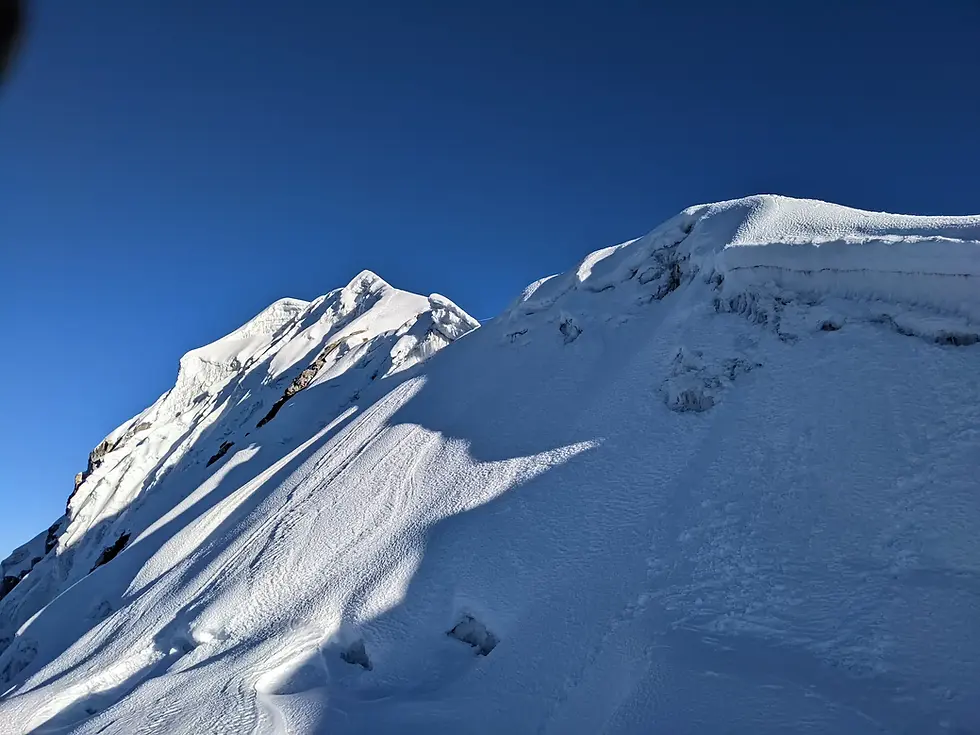
Now we are getting serious. If Island Peak seems too "touristy" to you, or you want to really test yourself, go for Lobuche East. It is very close to the Everest trail, but the feeling is totally different.
Why choose it? It is the perfect transition mountain if you dream of Ama Dablam in the future. Its pyramidal shape commands respect from below.
What you will encounter: It will demand more from you. Walking with crampons isn't enough here; there are steeper ice sections (about 45-50 degrees) where you will have to use the fixed ropes with decision and arm strength.
Watch out for one detail: Many commercial groups stop at the false summit. We always try to push for the true summit if conditions allow, but that final ridge is knife-edged and requires nerves of steel.
4. Tharpu Chuli (Tent Peak): The Jewel of the Sanctuary

Let's change the scenery and head to the Annapurnas. Tharpu Chuli is lower (5,663 meters), but don't be fooled by the altitude. I include it in this list because the experience is sublime.
Why choose it? Because you are in the middle of the Annapurna Sanctuary, a natural amphitheater surrounded by gigantic walls like Machapuchare or the South Face of Annapurna I. Climbing here feels much more intimate and visually dramatic.
What you will encounter: Technically, it is fun and challenging (Grade AD). It has a final wall that will make you sweat and smile in equal measure. It is the ideal option if you prefer greener landscapes during the approach (rhododendron forests, bamboo) and want to escape the crowds and dust of the Khumbu.
5. Chulu Far East: The Solitary Adventure

For the romantics looking for that old-school expedition feeling, Chulu Far East is my personal recommendation.
Why choose it? For the isolation. Located in the Manang region, north of the Annapurnas, just getting here is an adventure. We will likely be alone on the mountain.
What you will encounter: It is a peak that demands a long approach, which is great for acclimatizing little by little. The climb includes long snow slopes and a ridge that requires attention. It is perfect to combine with the famous Annapurna Circuit. If you are looking for silence and total disconnection, this is your place.
When to Pack Your Bags: Seasons
Spring (March - May): The most popular season. Temperatures are kinder, and it is the best time if you are going to Mera Peak or Chulu. The downside is that clouds often roll in during the afternoons, obscuring the views.
Autumn (October - November): My favorite for Lobuche or Island Peak. The air is clean after the monsoon, and visibility is crystal clear. It is colder and windier, yes, but the sky is usually so blue that the photos take themselves.


Comments